
August 7, 2026
Parking Lot Tree Requirements San Antonio: How Many Trees Does a Retail Lot Actually Need?
The parking lot tree requirements San Antonio enforces are not a flat tree count. The city requires a minimum 25 percent parking lot shade from large or medium trees, plus 70 elective landscape points overall, so the number of trees depends on lot square footage and mature canopy spread.
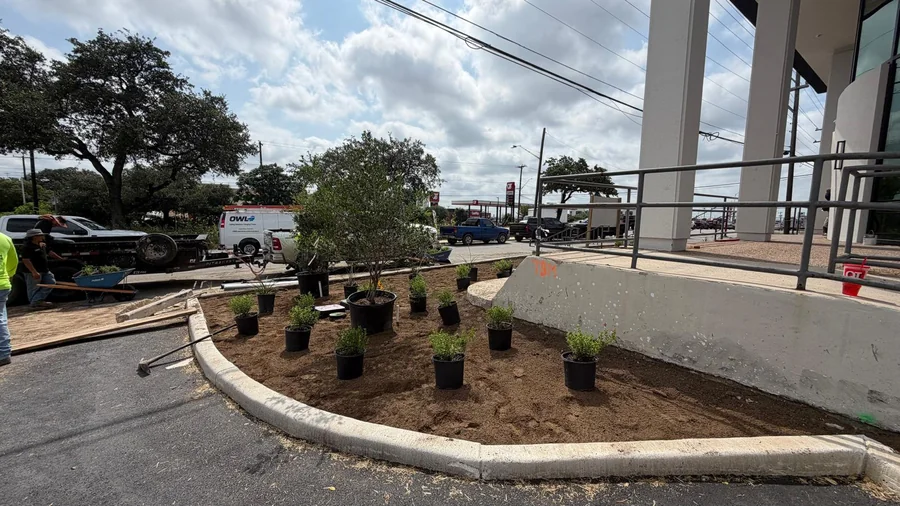
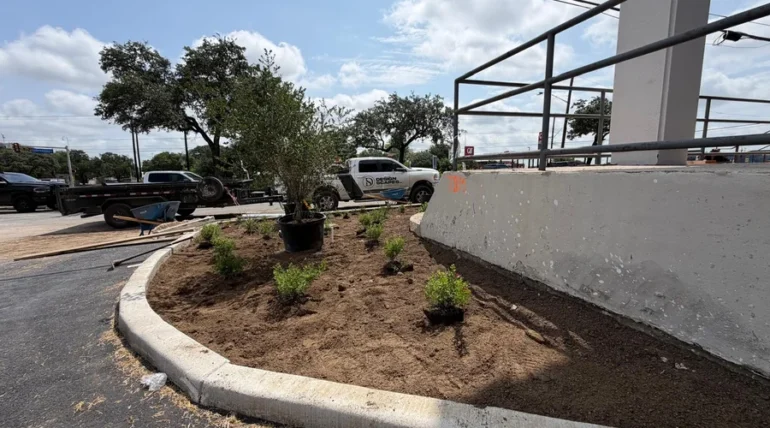
The parking lot tree requirements San Antonio applies to commercial property are the most misread part of the city’s landscape ordinance: managers expect a number and the code answers with a percentage. Two identical 40,000 square foot lots need different tree counts if one is planted in live oak and the other in a narrow ornamental.
What Are the Parking Lot Tree Requirements San Antonio Enforces?
San Antonio requires a parking lot to achieve at least 25 percent shade from large or medium canopy trees, and the overall site to earn 70 elective landscape points. There is no fixed “one tree per X spaces” rule in the Unified Development Code.
Shade is calculated from mature canopy spread over the paving, not from stem count. Extra canopy pays: 35 percent shade earns 5 points and 50 percent earns 15.
The 70-point minimum drops to 25 points when parking sits outside the street yard. Design Scapes reads both thresholds together, because canopy can carry a site short on points elsewhere. Detail is in the City of San Antonio landscape ordinance brochure.
When Do the Parking Lot Tree Requirements San Antonio Sets Get Triggered?
The ordinance is triggered by new construction, a building addition over 1,000 square feet or 10 percent, or a parking lot expansion over 2,000 square feet or 10 percent. Resurfacing and restriping an existing lot is not, by itself, an expansion.
Managers get this wrong both ways: some assume a mill-and-overlay pulls the site into current code, others add twelve spaces and never notice they crossed 2,000 square feet.
Treat this summary as general information. The parking lot tree requirements San Antonio applies to your parcel depend on zoning, street yard geometry and prior approvals, so confirm scope with the City’s Development Services Department before committing a capital number. The controlling text sits in the San Antonio Unified Development Code.
What Happens at Plan Review, and Why Does a Landscape Plan Get Rejected?
A landscape plan is checked on paper against the ordinance, then verified on the ground before a certificate of occupancy. Both steps measure the same things, which is why the parking lot tree requirements San Antonio enforces are cheaper to hit at design than to retrofit after paving.
Rejections cluster around a handful of repeat failures. The shade calculation is the most common: a plan that reaches 25 percent only by counting ornamental or small trees does not satisfy a rule written for large and medium canopy.
Island geometry is second. Islands drawn under 162 square feet of permeable surface, or trees inside the 30-inch setback from pavement or curbing, get flagged whether or not the shade math works.
The rest are documentation gaps: caliper not called out at 1.5 inches, no mulch depth noted, screening under 30 inches, or street trees past the 17-foot maximum interval. Confirm how the parking lot tree requirements San Antonio applies read on your parcel with Development Services.
What Are the Numbers Behind the Parking Lot Tree Requirements San Antonio Uses?
The specifications are dimensional and measurable at inspection.
| Specification | Requirement | On a retail lot |
|---|---|---|
| Parking lot shade | 25% minimum | Measured at mature canopy |
| Shade electives | 35% = 5 pts; 50% = 15 pts | Canopy buys points cheaply |
| Tree caliper | 1.5 inches minimum | Smaller stock will not count |
| Permeable area | 162 sq ft per tree | Undersized islands fail here |
| Setback | 30 inches minimum | From pavement or curbing |
| Parking screening | 30 inches high | Vegetation or hardscape |
| Street trees | 17-foot maximum intervals, 50-foot average | Starts at five spaces |
| Mulch | 4 inches | Required in planting areas |
Measure your islands before assuming the parking lot tree requirements San Antonio publishes are easy to hit. A single-stall island at 9 by 18 feet is 162 square feet exactly.
Is Replacing Dead Trees Part of the Parking Lot Tree Requirements San Antonio Applies?
Yes. The ordinance requires plant material to be maintained in a healthy condition, making the approved planting plan a standing obligation rather than a one-time inspection.
A lot approved at 25 percent shade that has since lost four canopy trees is no longer the lot the city approved. Replacement is the owner’s obligation, cheaper to budget than to be cited for.
What we see in the field: on retail landscaping in San Antonio takeovers, the common finding is a lot that passed at certificate of occupancy and has since lost 20 to 30 percent of its island canopy.
Why Do Parking Lot Trees Die in San Antonio Retail Centers?
They die from root zone failure far more often than from disease, which is why the parking lot tree requirements San Antonio sets for permeable area matter. The island is undersized, the subgrade compacted, and the irrigation designed for turf.
Add reflected heat off black asphalt in July and a young tree establishes in hot, airless clay. String-trimmer damage at the trunk flare girdles survivors.
Parking island survival: do and do not
Do this
- Rip the compacted subgrade before backfill
- Run drip or a bubbler to each island, zoned off turf
- Hold 4 inches of mulch, pulled back off the flare
- Edge the ring so trimmers never touch bark
- Replace losses the same season, same island
Do not do this
- Assume a turf rotor at the curb waters the tree
- Volcano-mulch the trunk over shallow planting
- Plant under 1.5-inch caliper to save budget
- Grind a stump and leave the island empty
Field practice used by Design Scapes to keep islands alive under the parking lot tree requirements San Antonio enforces.
San Antonio Water System has enforced Stage 2 drought rules since August 4, 2026, and tree bubblers and drip may run only Monday and Friday, from 5 to 10 a.m. or 9 p.m. to midnight, per the SAWS Stage 2 drought restrictions.
How Does the Oak Wilt Window Change When You Can Prune?
Do not prune oaks in Central Texas from February through June, and paint every oak wound immediately, year-round. That guidance comes from the Texas A&M Forest Service oak wilt program.
For a lot planted heavily in live oak, which most San Antonio centers are, that closes five months to structural pruning. Clearance work over drive aisles compresses into July through January.
Design Scapes schedules oak work between July and January and holds other species for the spring gap, an approach covered in our winter tree trimming guide for San Antonio properties. Storm work on oaks still happens when it happens, wound painted immediately, and that calendar is part of meeting the parking lot tree requirements San Antonio enforces.
Which Trees Actually Survive a San Antonio Parking Island?
Live oak, cedar elm, Texas red oak and Mexican sycamore hold up in San Antonio parking islands. They combine heat and alkaline soil tolerance with enough spread to move the shade percentage the parking lot tree requirements San Antonio turn on.
| Species | Why it works here | Watch out for |
|---|---|---|
| Live oak | Broad evergreen canopy, best shade per tree | Oak wilt window; wants more than 162 sq ft |
| Cedar elm | Native, handles compaction and alkaline clay | Slower to fill; narrow when young |
| Texas red oak | Good scale for medium islands, fall color | Same February to June pruning ban |
| Mexican sycamore | Fast canopy, strong summer shade | Wants water to establish; heavy leaf drop |
In a tight island, skip surface-rooting trees like Arizona ash and silver maple, and do not count crape myrtle toward shade. It will not satisfy the parking lot tree requirements San Antonio measures at mature canopy.
Does Keeping a Mature Tree Beat Planting to the Parking Lot Tree Requirements San Antonio Sets?
Usually it does, because shade is measured at mature canopy spread. An existing large tree already casts the canopy a newly planted 1.5-inch caliper tree will not cast for years, so every mature tree kept on site is shade you neither buy nor wait for.
The cost comparison is not close. A new ordinance tree carries stock, install labor, an island built to 162 square feet of permeable surface, irrigation to that island, mulch, staking and three years of establishment care before it casts much shade.
Preservation has one real cost: protection during construction. Root zones inside the dripline get compacted by staging, trenching and grade changes, and a tree injured that way dies two to four years later.
Fence the protected zone before mobilization, keep traffic and stockpiles off it, and route utilities around it. Ask Development Services how existing trees count on your parcel, because that answer sets the planting count you need to satisfy the parking lot tree requirements San Antonio holds the site to.
What Does the First Three Years of Establishment Care Look Like?
A tree is established when its roots push past the backfill into native soil, which in San Antonio clay under reflected asphalt heat takes roughly three years. Nearly every lot tree that dies young dies inside that window, and the parking lot tree requirements San Antonio enforces do not pause while it happens.
Establishment schedule for a newly planted lot tree
Water deeply. Under SAWS Stage 2, in effect since August 4, 2026, drip and bubblers run Monday and Friday only, so a hand-held hose, allowed any day, fills the gap.
Hold 4 inches of mulch across the ring, pulled back off the trunk flare, and re-edge it after storms so trimmers never reach bark. Pull the stakes by month 15; left on, ties girdle the trunk and the tree never builds supporting taper.
Verify the curbing or wheel stops required in street yards, add a guard where carts and doors strike, and make only light structural cuts, keeping oaks outside February through June.
Reduce supplemental water as roots reach native soil, then measure canopy against the approved plan and replace losses in the same island the same season.
Establishment practice Design Scapes uses on lots held to the parking lot tree requirements San Antonio enforces.
Do Root Barriers and Island Sizing Change the Parking Lot Tree Requirements San Antonio Enforces?
They do not change what the code asks, but they decide whether you still meet it in year eight without tearing out pavement. The 162 square feet of permeable surface is a minimum, and a large canopy species planted at it will send roots under the curb hunting water and air.
Root barriers redirect roots downward and away from the pavement edge rather than stopping them. They work when installed along the pavement line at planting time and do very little when retrofitted around a tree that has already lifted a panel.
Structural soil is the other approach: an engineered mix that carries paving loads while keeping pore space for roots, so rooting volume continues under the pavement instead of ending at the island curb. It costs more at install and less at year fifteen.
Size the island to the species, not to the minimum. A live oak dropped into a single-stall island at exactly 162 square feet is the classic San Antonio retail mistake: it passes on inspection day and becomes a heaved trip hazard two decades later.
When Does a Compliance Issue Become a Trip Hazard?
Root heave is where the parking lot tree requirements San Antonio enforces turn into a liability question. A canopy tree at the minimum 30-inch setback will, over 15 to 20 years, lift the island edge or adjacent walkway.
Texas premises liability holds an owner to a duty to make safe or warn an invitee of dangerous conditions the owner knew or should have known about. Confirm your exposure with counsel and your insurer.
The answer is dated inspection of island edges and walk joints, root pruning or panel replacement on a schedule, plus a written record. Design Scapes builds that into commercial landscaping across Bexar County and office building and business park grounds.
Key takeaways
- The parking lot tree requirements San Antonio enforces begin with a minimum 25 percent shade from large or medium trees, not a fixed tree count, as of August 2026.
- The ordinance triggers on new construction, an addition over 1,000 sq ft, or a lot expansion over 2,000 sq ft (or 10 percent).
- New trees need 1.5-inch caliper, 162 sq ft of permeable surface, and 30 inches of setback.
- Plant material must be maintained in a healthy condition, so replacing dead trees is the owner’s obligation under the parking lot tree requirements San Antonio applies.
- Oaks in Central Texas must not be pruned February through June, which compresses structural work into July through January.
FAQs About Parking Lot Tree Requirements San Antonio Managers Ask
How many trees does a San Antonio parking lot need?
There is no flat number. San Antonio requires a minimum 25 percent shade from large or medium canopy trees, calculated at mature canopy spread. The parking lot tree requirements San Antonio publishes also include a 70-point elective landscape total, or 25 points when parking sits outside the street yard.
Does resurfacing a parking lot trigger the landscape ordinance?
Resurfacing and restriping an existing lot does not by itself trigger the parking lot tree requirements San Antonio sets for new work. The ordinance is triggered by new construction, a building addition over 1,000 square feet or 10 percent, or a parking lot expansion over 2,000 square feet or 10 percent. Confirm your project with the City’s Development Services Department.
Do I have to replace parking lot trees that died?
Yes. The ordinance requires plant material to be maintained in a healthy condition, so a lot approved at 25 percent shade that has lost canopy trees is no longer what the city approved. Under the parking lot tree requirements San Antonio applies, replacement is the property owner’s obligation rather than an optional expense.
How big does a parking island have to be?
Each new tree needs at least 162 square feet of permeable surface and must sit at least 30 inches from pavement or curbing. In street yards, trees must be protected by curbing or wheel stops. A single-stall island at 9 feet by 18 feet meets 162 square feet exactly.
When can oaks on a commercial lot be pruned in San Antonio?
Oaks in Central Texas should not be pruned from February through June because of oak wilt transmission risk, according to the Texas A&M Forest Service. Every oak wound should be painted immediately, in any month. For a center planted in live oak, that compresses structural pruning into July through January.
How high does parking lot screening have to be?
Surface parking in San Antonio must be screened by vegetation or hardscape at least 30 inches high. Sites with five or more spaces also trigger streetscape standards, requiring street trees at a maximum of 17-foot intervals and averaging 50 feet apart, separate from the parking lot tree requirements San Antonio sets for shade.
Want a straight answer for your property?
Design Scapes has maintained San Antonio commercial grounds since 2012. We will walk your retail center or standalone store, measure the turf and bed areas, and send an itemized scope and price with no obligation.
Count your canopy before calling anyone. Design Scapes holds TCEQ irrigator license LI0028680 and has maintained Bexar County grounds since 2012; our shopping center grounds maintenance program and commercial tree trimming service are built around the parking lot tree requirements San Antonio holds owners to.