
August 13, 2026
Office Park Grounds Maintenance in San Antonio: What Does a Full-Year Program Actually Cover?
A full-year office park grounds maintenance program in San Antonio is a 12-month schedule with defined work every month, typically 36 to 42 site visits weighted toward April through October. It covers dormant pruning, pre-emergent, mulch, irrigation audits, mowing, aeration, seasonal color and freeze prep, not only mowing.
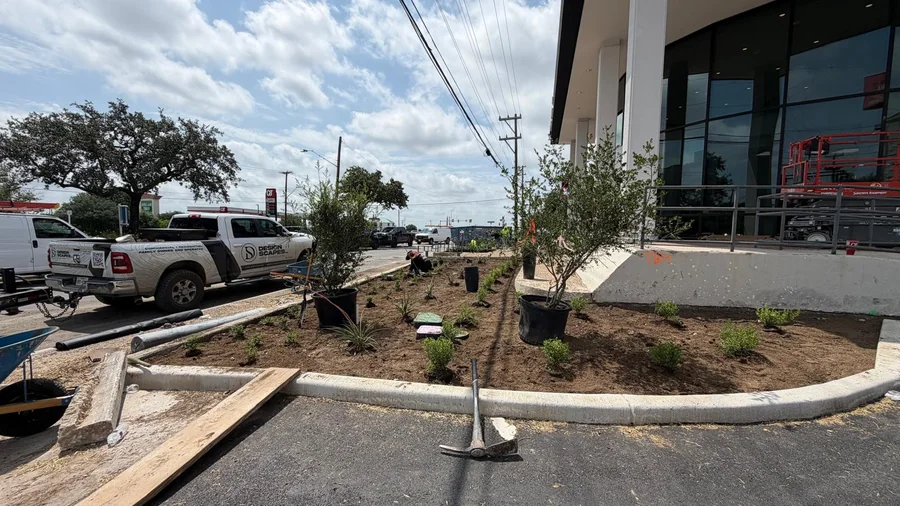
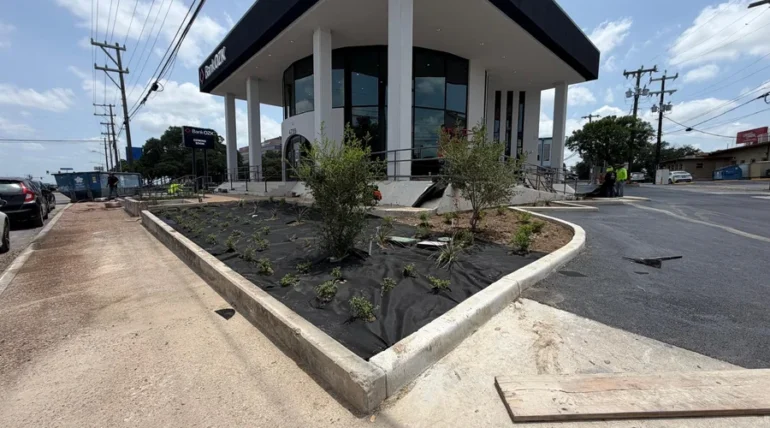
Office park grounds maintenance is bought once a year and judged every day, which is why the contract you sign in September decides how the property looks the following August. Design Scapes has maintained San Antonio commercial grounds since 2012.
Most annual scopes fail in the same place. They price mowing well and leave January, February and November nearly blank, so the property enters spring behind.
What does an office park grounds maintenance program include?
Scheduled work in all twelve months, not a mowing route that pauses when turf stops growing. A real office park grounds maintenance program in San Antonio runs 36 to 42 visits a year: weekly April through October, then biweekly or monthly in the cool season.
Winter visits separate a program from a route. Dormant pruning, bed renovation, drainage checks and irrigation repair happen when turf is dormant, which is how we build our office building landscaping program for San Antonio business parks.
What does the office park grounds maintenance calendar look like month by month?
Every month carries named work. The office park grounds maintenance calendar below is what a San Antonio manager should hold a vendor to.
| Month | Core scheduled work | Watch for |
|---|---|---|
| January | Dormant pruning of non-oaks, bed cleanup, hardscape and drainage inspection | Standing water at curb cuts |
| February | Pre-emergent weed control; non-oak pruning finished | Oak wilt window opens: no oak pruning until July |
| March | Mulch to 3 to 4 inches, spring color changeover, first mowing as St. Augustine and Bermuda green up, irrigation activation | Heads broken over winter |
| April | Fertilization, weekly mowing begins, weed control, edging | Weed escapes where pre-emergent was thin |
| May | Full irrigation audit, run times set by zone | Take-all root rot in thinning St. Augustine |
| June-August | Peak mowing and edging, hand watering, canopy raised over walkways and drives | Chinch bugs on sunny edges; Stage 2 triage |
| September | Core aeration, fall fertilization, grub damage assessment | Turf lifting over grub-fed roots |
| October | Fall color changeover, overseeding decision | Brown patch as nights cool |
| November | Leaf management, freeze prep, drain-down and backflow insulation, cool-season color | Exposed backflow before first freeze |
| December | Reduced-frequency visits, holiday lighting if in scope, year-end walk | Deferred items rolling into next year |
The office park grounds maintenance year in six moves
Dormant pruning on non-oaks, bed and drainage work, pre-emergent.
Mulch, spring color, first mow, activation that finds broken heads.
Fertilization, weekly mowing, bed edges, May irrigation audit.
Peak mowing, chinch bug scouting, hand watering, canopy raising.
Core aeration, fall fertilization, grub check, fall color.
Leaves, freeze prep, drain-down, backflow insulation, year-end walk.
Office park grounds maintenance timing reflects San Antonio conditions as of August 2026.
Why does the oak wilt window control pruning in office park grounds maintenance?
Because most San Antonio business parks are planted with live oaks, and oaks must not be pruned February through June in Central Texas. The Texas A&M Forest Service oak wilt guidance puts oak work in the July through January window, and every wound gets painted immediately.
Canopy raising therefore happens in January or waits for July, which is why commercial tree trimming in San Antonio belongs in the annual scope.
What belongs in an office park grounds maintenance contract?
The terms managers leave out are the terms they later argue about. A defensible office park grounds maintenance contract names frequencies, heights, response times and reporting.
| Contract clause | What it should say | Why it matters |
|---|---|---|
| Visit count | A stated annual number by season | Ends the “we were out there” argument |
| Mowing height | A set height for St. Augustine, lower for Bermuda | Scalped turf invites weeds and disease |
| Litter policing | Parking areas and islands policed every visit | Trash is what tenants photograph |
| Irrigation response | Hours to stop a break, days to repair | A running break wastes water |
| Storm cleanup | What is included, how extra is billed | Prevents a surprise invoice |
| Plant warranty | A replacement period on installed material | Puts selection risk on the installer |
| Color changeovers | A number per year and the beds included | No count means one rotation |
| Contact and reporting | A named contact, dated reports with photos | Gives ownership an evidence trail |
What we see in the field: on San Antonio office parks we have walked since 2012, the scopes that survive an ownership change are the ones with a visit count and a photo log.
Why is the entrance the whole job in office park grounds maintenance?
Because tenants, their clients and every touring prospect form an opinion at the monument sign and front drive. Weight the budget toward that first 200 feet.
Four things carry an entrance: clear sight lines at the drive approach, canopy raised to one consistent clearance over walkways and drive lanes, crisp bed edges at the doors, and light on the sign after dark. Inconsistent canopy height is the tell.
How does office park grounds maintenance affect tenant retention?
It changes the renewal conversation. A manager touring a prospect past clean edges, full beds and lit walkways is selling; one apologizing for dead turf at the entrance is negotiating.
Grounds are the one complaint category a tenant sees from their own window. Consistent work removes an easy objection at renewal, a practical benefit rather than a measurable one.
How do SAWS Stage 2 rules change watering at a business park?
San Antonio Water System has enforced Stage 2 drought rules since August 4, 2026, limiting irrigation systems to one day a week, from 5 to 10 a.m. or 9 p.m. to midnight. The day is set by the property’s street address.
Areas without a street address, such as medians and common entryways, water on Wednesday, so one business park can hold two legitimate watering days. Full rules are published in the SAWS Stage 2 drought restrictions.
Drip and tree bubblers run Monday and Friday, and a hand-held hose may be used any time, which is why hand watering sits in the summer scope.
Who is licensed to touch irrigation and backflow at an office park?
In Texas, irrigation work must be performed or supervised by a TCEQ-licensed irrigator. Design Scapes holds license LI0028680 and is insured.
Backflow assemblies must be tested annually under the SAWS annual backflow testing program. An untested assembly is an exposure for the owner, not the vendor, so the test date belongs on the calendar with sprinkler repair for commercial sites.
What separates real office park grounds maintenance from a mowing contract?
Defined work in the months when nothing is growing. A mowing contract is priced on turf; office park grounds maintenance is priced on the whole site.
Annual program versus mowing route
Expect in an annual program
- A stated visit count for the year
- Named work in January, February and November
- Mowing heights set per turf species
- Spring activation and a May irrigation audit
- Dated service reports with photos
Do not accept as the whole scope
- “Mow, edge and blow, weather permitting”
- Seasonal color with no rotation count
- Irrigation repair with no response time
- Storm cleanup with no billing terms
- Oak pruning quoted for spring
How Design Scapes scopes office park grounds maintenance for San Antonio business parks, August 2026.
An office building and business park landscaping contract in San Antonio should read like a calendar with prices attached, as does retail center grounds care and the rest of our commercial landscaping work across Bexar County.
What should happen in the first 90 days of a new office park grounds maintenance contract?
A transition, not a mowing start. The first 90 days of an office park grounds maintenance contract decide whether the incoming vendor inherits a clean baseline or an argument about who caused what.
Week one is a joint site walk with the outgoing vendor where that is possible. Photograph the entrance, every turf area, every bed, the detention area and the backflow assembly the same day, and date the file.
Next comes the baseline site inventory: mowable acreage by area, bed square footage, tree count by species, irrigation zone count, controller locations, and the street address that sets the SAWS watering day. Managers who skip this pay at the first change order, because nobody can prove what the property held on day one.
Then the inherited punch list, split before any work starts into what the vendor absorbs and what the owner funds.
| Inherited condition | Whose cost it normally is | When it gets corrected |
|---|---|---|
| Shrubs sheared into boxes, interiors thin | Vendor, inside the maintenance scope | Across the first two pruning cycles |
| Beds running thin on mulch | Owner, as a one-time restoration | Before the March mulch cycle |
| Broken heads, buried or cracked valve boxes | Owner, billed as irrigation repair | Found at spring activation, quoted in writing |
| Dead or missing plant material | Owner, unless the new vendor installed it | Fall or spring planting window |
| Turf lost to compaction or grub feeding | Owner, as renovation | September aeration, then reassess |
| Backflow assembly with no current test | Owner; annual testing is the owner’s duty | Inside the first 30 days |
Attach it to the agreement as a dated exhibit, with a correction date and a cost owner on every line. A program that opens that way rarely produces a year-two argument about pre-existing condition.
How is office park grounds maintenance divided when a park has more than one owner?
By a written map, not by habit. Multi-building parks in San Antonio often hold separate pad owners, a ground lease or two and an owners’ association controlling the drives, so office park grounds maintenance responsibility has to be drawn before it is priced.
Shared drives cause the first argument. Islands, medians and the entry monument often sit on association land while turf 20 feet away belongs to a pad owner, and one crew crosses both boundaries without noticing either.
Shared detention areas cause the second. A detention basin is common area in most parks, it is cut on a different frequency than the front lawn, and its side slopes and outfall need inspection after a storm rather than a weekly pass.
Three rules keep this clean: number every zone on a site map with a drawn boundary, state which entity funds each zone, and name one person who approves extras.
Watering compliance follows the same map. Common areas without a street address, including medians and entry beds, water on Wednesday under SAWS Stage 2, while each addressed building keeps its assigned day, so one park legitimately runs two schedules.
What should the monthly office park grounds maintenance report contain?
Enough that a manager can forward it upward without rewriting it. A monthly office park grounds maintenance report should carry service dates, completed tasks by area, irrigation findings, deferred items with reasons, and entrance photos taken from a fixed vantage point.
The fixed vantage point is the detail vendors skip and asset managers use. Three shots from the same three spots each month become a year of comparable evidence.
A deferred item deserves its own line. Deferred with a reason and a target month, it reads as a management decision; missing from the report entirely, it reads as a lapse.
Feed the package straight into the monthly ownership report and the annual budget defense, and paste the photo page in rather than describing it in prose.
How much of an office park grounds budget is really water?
More than the operating statement usually shows, because irrigation lands on the water bill instead of the landscape line. A tuned controller is a budget item as much as a horticultural one, and office park grounds maintenance is where that tuning happens or fails to.
Under SAWS Stage 2, in effect since August 4, 2026, an irrigation system gets one day a week inside a five-hour morning window or a three-hour night window, so run times carry the whole season. A zone still running a schedule written years ago either wastes the window or floods one bed.
Three adjustments move the bill: heads reset to grade so water lands on turf rather than pavement, matched precipitation within each zone, and drip converted to run Monday and Friday instead of competing for the single spray day.
SAWS also runs an annual irrigation checkup and a custom rebate through its commercial conservation programs and rebates, so ask whether the site qualifies before funding a retrofit from reserves. Treat a running break during a one-day window as a water charge as well as a compliance problem.
Key takeaways
- A San Antonio office park grounds maintenance program runs 36 to 42 site visits a year, weighted to April through October.
- Oaks must not be pruned February through June in Central Texas; oak work belongs in the July through January window.
- SAWS Stage 2, in effect since August 4, 2026, limits irrigation to one day a week; medians and entryways water on Wednesday.
- Backflow assemblies require annual testing, and Texas irrigation work requires a TCEQ-licensed irrigator.
- A defensible contract names visit count, mowing heights, irrigation response time and dated photo reporting.
Office park grounds maintenance FAQ for San Antonio managers
How many visits should an annual grounds contract include?
Most San Antonio office parks run 36 to 42 visits a year: weekly April through October while St. Augustine and Bermuda grow, then every other week or monthly November through March. Put the number in the contract, because visit count is easy to verify against a dated log.
When can oaks be pruned at a San Antonio business park?
Prune oaks July through January and leave them alone February through June, the high-risk oak wilt window in Central Texas identified by the Texas A&M Forest Service. Paint every oak wound immediately, in any month, including trimmer damage. Non-oaks take structural pruning in January.
How often can a business park irrigate under SAWS Stage 2?
San Antonio Water System has enforced Stage 2 since August 4, 2026, allowing irrigation systems one day a week, from 5 to 10 a.m. or 9 p.m. to midnight, on the day set by the street address. Medians and entryways without an address water on Wednesday.
What should office park grounds maintenance reporting look like?
Reporting should be dated, photographic and tied to the scope: service date, completed tasks, irrigation issues found, and photos of the entrance. Office park grounds maintenance reporting of that quality gives ownership an evidence trail for budget defense and inspection records. Confirm requirements with your counsel.
What turf problems show up most on San Antonio commercial sites?
Four recur. Chinch bugs hit hot, dry, sun-exposed turf edges June through September. Take-all root rot thins St. Augustine in spring. Brown patch causes circular yellowing in the damp fall. Grubs appear in late summer, which is why September core aeration belongs in every office park grounds maintenance scope.
Should winter months be billed at the same monthly rate?
Many San Antonio office parks use a level monthly rate spreading the annual scope across twelve payments, which keeps the budget flat and funds winter work. Billing by visit is the alternative. A level rate only works when the winter scope is written out, or office park grounds maintenance value disappears.
Want a straight answer for your property?
Design Scapes has maintained San Antonio commercial grounds since 2012. We will walk your office park or business park, measure the turf and bed areas, and send an itemized scope and price with no obligation.
Office park grounds maintenance is easiest to judge in the months nobody thinks about, so read your scope for January and November before July.