
August 18, 2026
Can Landscaping Create a Commercial Property Trip Hazard – and Liability – in Texas?
Yes. Landscaping regularly creates a commercial property trip hazard: root heave lifting slabs, irrigation heads proud of grade, mulch washed across a walk. Texas premises liability generally requires an owner to make safe or warn invitees of a dangerous condition it knew or should have known about. Take your own situation to your attorney and insurer.
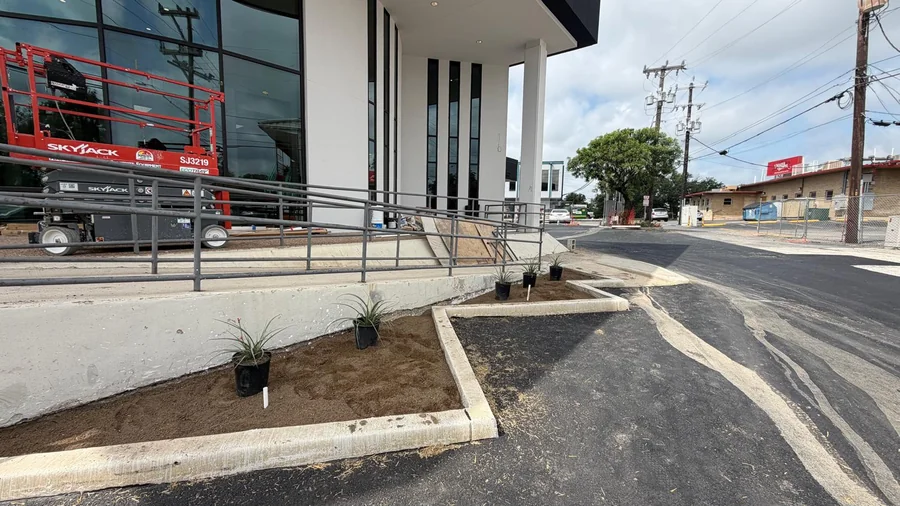
A commercial property trip hazard at a San Antonio retail center, apartment community or office park is usually created by the landscape, not the original concrete. Roots move slabs. Heads settle. Shrubs grow into sight lines. Below is the general Texas standard and the documentation routine behind it – general information, not legal advice.
What makes a commercial property trip hazard a legal problem in Texas?
In broad terms, a Texas property owner owes an invitee – a shopper, tenant or customer – a duty to make safe or warn of an unreasonably dangerous condition the owner knew about or should reasonably have known about.
Most disputes do not turn on whether the defect existed; photographs settle that. They turn on the second half: did the owner know, or should it have known? That is a documentation question before it is a legal one. Every claim turns on its own facts, so take yours to counsel.
Which landscape features become a commercial property trip hazard first?
Root heave leads. Live oaks and cedar elms planted at the ordinance minimum of 30 inches from pavement eventually reach it, and a root under a slab lifts the slab.
| Landscape-created defect | Where it shows up | The fix |
|---|---|---|
| Root heave | Walkway slabs, curb transitions, island edges | Grind or replace the slab; root-prune under an arborist |
| Heads proud of grade, settled valve boxes | Turf edges beside walks | Reset to grade on swing joints; replace cracked lids |
| Low limbs | Walks and drive lanes, worst after rain | Raise to one clearance; re-check after storms |
| Overgrown shrubs | Sight triangles at drive exits | Cut below sight line; replant dwarf yaupon |
| Shrubs over lights and cameras | Walks dark at dusk | Prune clear of the lens; re-aim |
| Mulch and granite washout | Sidewalks below beds after storms | Sweep and reset headers |
| Worn desire lines | Turf strips people cut across | Level and re-sod, or build the walk |
| Missing wheel stops | Island edges and end-cap spaces | Replace the stop or repair the curb |
A drooped limb is a head-strike risk too: someone ducking is not watching the slab. Washout is a slip exposure rather than a commercial property trip hazard, but belongs on the same sheet.
How do you document a commercial property trip hazard inspection?
The routine matters more than any single walk. A defensible record is a repeated, dated, same-route inspection producing photographs and a written log, with a closeout date on each item.
A commercial property trip hazard inspection routine that produces a record
Monthly suits most retail centers. Define it in advance, not after an incident.
Entries, walks, island edges, drive exits, dumpster approach.
Include something for scale. Shoot clean areas too; a photo showing no defect on a date is evidence.
Location, finding, measured displacement, severity, and who assigned it.
Severity sets the response window, defined by policy before the walk.
Repair date, who did it, an after photo. An open item with no closeout is the weakest line.
General guidance on commercial property trip hazard inspection. Your risk management policy and insurer govern.
A vendor’s dated service reports become part of that record whether anyone planned it or not. When the question is “was the canopy raised, and when?”, a dated report answers it and a memory does not. Design Scapes issues dated service documentation on commercial accounts.
How fast should each commercial property trip hazard be fixed?
Severity drives the window. These tiers are a common way property teams sort a commercial property trip hazard list; your own risk management policy governs.
| Tier | Typical examples | Response |
|---|---|---|
| Cone or barricade today | Slab displacement a toe would catch, missing valve box lid | Mark or isolate on the spot, then schedule |
| Schedule this week | Head slightly high, shrub in a sight triangle, foliage over a light | Next service visit, work order dated |
| Capital cycle | A run of heaved slabs, a curb line failing over 60 feet, a tree outgrowing its island | Budgeted, with an interim control |
The interim control is the step people skip. If a heaved run goes into next year’s budget, the file should show what was done meanwhile.
Who is responsible for a commercial property trip hazard, owner or vendor?
In general terms, an owner cannot contract its duty to invitees away to a vendor. A grounds contract can create a reporting obligation and a paper trail.
What a grounds contract can and cannot do about a commercial property trip hazard
Reasonable to put in the contract
- Reporting observed hazards in writing to a named person
- A defined reporting path for urgent items
- Dated service reports every visit
- Canopy clearance and sight triangle standards
Stays with the property owner
- The underlying duty owed to invitees
- Severity tiers and remediation windows
- Capital repairs to walks, curbs and wheel stops
- Notifying the carrier and involving counsel
A vendor on site weekly sees what a monthly visitor does not, so that reporting path belongs in the scope for retail and shopping center landscaping in San Antonio and apartment and multi-family grounds maintenance.
How does oak wilt season change a commercial property trip hazard fix?
The Texas A&M Forest Service oak wilt program advises against pruning oaks February through June in Central Texas, when the beetles that spread the fungus are active. A low limb found in March is a scheduling problem, not a simple work order.
In that window: raise non-oak canopy, cone or reroute foot traffic under the limb, and have a qualified arborist confirm whether an immediate safety cut is warranted. Paint every oak wound immediately, in any month. Design Scapes schedules oak work around it and our commercial tree trimming crews carry pruning paint.
What we see in the field: the limbs that draw complaints are rarely the ones that were low at the last trim. They are limbs raised to 8 feet that grew, then bent lower under a wet canopy after a May storm. Clearance is a seasonal measurement.
Which San Antonio rules shape a commercial property trip hazard on site?
The City of San Antonio landscape ordinance sets the conditions that produce the defect: trees at least 30 inches from pavement, 162 square feet of permeable surface each, wheel stops protecting street-yard trees, and 25 percent minimum lot shade. The Unified Development Code also requires plant material to be kept healthy.
Drought rules constrain the cleanup. SAWS Stage 2, in effect since August 4, 2026, prohibits washing driveways, parking lots, streets and sidewalks, so a slick walk gets swept or cleaned mechanically unless SAWS grants a health and safety exception. Where foliage has darkened a walk, pruning and landscape lighting repair are the fixes.
Design Scapes has maintained commercial landscaping across Bexar County since 2012 and holds TCEQ irrigator license LI0028680, which matters because resetting heads and valve boxes to grade is irrigation work. Where one walkway keeps failing, our shopping center grounds maintenance program pairs that record with a hardscape scope.
Does a commercial property trip hazard look different after dark?
Often, yes. A walk at 10 a.m. tells you where the concrete is; a walk at 9 p.m. tells you what a customer can see, and a commercial property trip hazard obvious at noon can be invisible under a canopy at night.
Vegetation changes it. A live oak that cleared a pole-mounted fixture in March can close over it by August, and light that landed on a walkway edge now lands on the top of a shrub.
The shift is gradual, so nobody reports it. Walk the same route after dark twice a year, in late spring and in fall after growth has run, and look for fixtures screened by foliage, dark gaps between pools of light, shadowed grade changes at curb transitions, and hazed lenses.
The fix is usually pruning before it is electrical: cut foliage clear of the lens, re-aim the fixture, then check the lamp. Whether any of it bears on a claim turns on that incident’s facts, so set your lighting standard with counsel and the property’s insurer.
What does a Texas storm or ice event leave behind on walkways?
Debris, grit and broken limbs. Central Texas sees ice rarely, which is the problem: a San Antonio commercial site has no snow-clearing routine, and one hard freeze can leave an entry landing glazed at 7 a.m. and dry by 10.
| Event | What it leaves on walking surfaces | First response |
|---|---|---|
| Hard freeze or ice event | Glazed walks, entry landings and metal stair treads at dawn | Barricade or reroute the entry, then re-check mid-morning |
| Hail | Shredded foliage, bark and leaf litter across walks and drives | Blow and sweep walks first, then drives; inspect limbs |
| Windstorm | Downed limbs and hangers, meaning partly broken limbs still lodged in the canopy, which come down later | Cordon under hangers; arborist assessment before reopening |
| Heavy rain | Mulch and granite washed across sidewalks, silt at curb cuts | Sweep and reset bed headers; find why the header failed |
Sequence matters as much as the work: entries first, then main pedestrian routes, then drives and parking. Photograph each area before and after with the date, because a storm week is when documentation usually stops and when a commercial property trip hazard is most likely to be reported.
One local constraint shapes the cleanup: SAWS Stage 2 has prohibited washing driveways, parking lots, streets and sidewalks since August 4, 2026, so post-storm work is sweeping and mechanical cleaning unless SAWS grants a health and safety exception.
Who owns a commercial property trip hazard created by another vendor?
The owner still owes its duty to invitees, whoever made the mess. Who repairs it, how fast, and who pays are contract and insurance questions for your counsel and carrier.
Temporary hazards outnumber permanent ones on an active site: ladder feet set across a walk, an open trench at a plumbing repair, a delivery pallet on a sidewalk, cords run across a pedestrian route, hoses left by a window-washing crew.
Seasonal and event traffic adds more: holiday display anchors, staked signage, tent stakes and guy lines at a leasing event, cords run to a food truck. Each is a commercial property trip hazard whose creator leaves at 5 p.m.
Three controls handle most of it: require every vendor to state its pedestrian and traffic control in writing before mobilizing, require cones, tape or plating for anything crossing a walking route, and require the site returned to walkable condition at the end of each work day.
Then verify it yourself. A vendor’s promise about barricades is not a record; a dated photograph of the barricade in place is. Add live work areas to the inspection route, and log the date the work ends.
How should a tenant’s commercial property trip hazard report be logged and closed out?
In writing, the day it arrives, in the same log as your own inspections. A tenant email describing a broken walkway is notice, and an unanswered one is the worst record a property file can hold: it shows somebody knew and shows nothing after that.
Give tenants and residents one channel and tell them what it is. A ticket type landing in a monitored queue beats a note handed to a leasing agent, since only one of those creates a dated record.
Log five fields in the commercial property trip hazard log: date received, who reported it, the exact location, what they described, and who owns it now. Acknowledge to the reporter the same business day, even if the answer is that the repair is scheduled for next month.
Close the loop twice: in the log with the repair date, who performed it and an after photo, and back to the person who reported it. The file then shows a report received, assessed, corrected and answered. No procedure prevents liability, and every claim turns on its own facts, so review yours with counsel and the property’s insurer.
Key takeaways
- Texas premises liability generally requires an owner to make safe or warn invitees of an unreasonably dangerous condition it knew or should have known about.
- Root heave from mature live oaks and cedar elms is the most common landscape-created commercial property trip hazard in San Antonio.
- A defensible commercial property trip hazard record is a defined interval, fixed route, dated photographs, a written log, and a dated closeout.
- The Texas A&M Forest Service advises against pruning oaks February through June in Central Texas, so a spring limb needs an interim control.
- SAWS Stage 2, in effect since August 4, 2026, prohibits washing sidewalks and parking lots.
Commercial property trip hazard FAQ for San Antonio property managers
Is landscaping really a common source of premises claims?
Landscape elements are a routine source of walking-surface defects: heaved slabs over tree roots, irrigation heads above grade, settled valve box lids and washed-out mulch. Whether a condition supports a claim depends on the facts of that incident. This is general information, not legal advice; ask your attorney.
How often should a property be inspected for a commercial property trip hazard?
No statute sets a single interval. Many San Antonio retail and multi-family owners walk their commercial property trip hazard route monthly and check high-traffic entries more often, with the interval written into a risk management policy in advance. What matters is that it was defined beforehand, followed, and documented.
Does a grounds contract transfer liability for a commercial property trip hazard?
Generally an owner cannot contract its duty to invitees away to a landscape vendor, though contracts do allocate responsibilities and reporting duties. A good scope requires the vendor to report observed hazards in writing and issue dated service reports. How your own agreement allocates that is a question for counsel.
What should be done about a low oak limb found in April?
The Texas A&M Forest Service advises against pruning oaks February through June in Central Texas because of oak wilt. The usual approach is to cone or reroute foot traffic under the limb, raise non-oak canopy instead, and let an arborist decide whether a safety cut is warranted.
Can we pressure wash a stained sidewalk right now?
Not as routine cleaning. SAWS Stage 2 drought rules, in effect since August 4, 2026, prohibit washing driveways, parking lots, streets and sidewalks in San Antonio. Sweeping and mechanical cleaning are the options left. SAWS does allow a health and safety exception to be requested.
What documentation matters most after an incident?
The commercial property trip hazard inspection log covering that location before the incident, dated photographs from those walks, the vendor’s dated service reports, work orders showing severity and remediation window, and the closeout record. Notify your carrier and involve counsel promptly. No procedure prevents liability.
Want a straight answer for your property?
Design Scapes has maintained San Antonio commercial grounds since 2012. We will walk your retail center, apartment community or office property, measure the turf and bed areas, and send an itemized scope and price with no obligation.
Landscaping will keep producing a commercial property trip hazard on any mature San Antonio site. The useful response is a routine that finds each commercial property trip hazard on schedule, records it with a date, and closes it out in writing – reviewed with your attorney and insurer.